
31 Mar Building a More Resilient Warehouse Through Better Storage Design
The global supply chain landscape is defined by constant adaptation. Organizations have moved away from rigid, linear models toward more flexible operations. This shift comes from factors such as nearshoring and frequent seasonal demand surges.
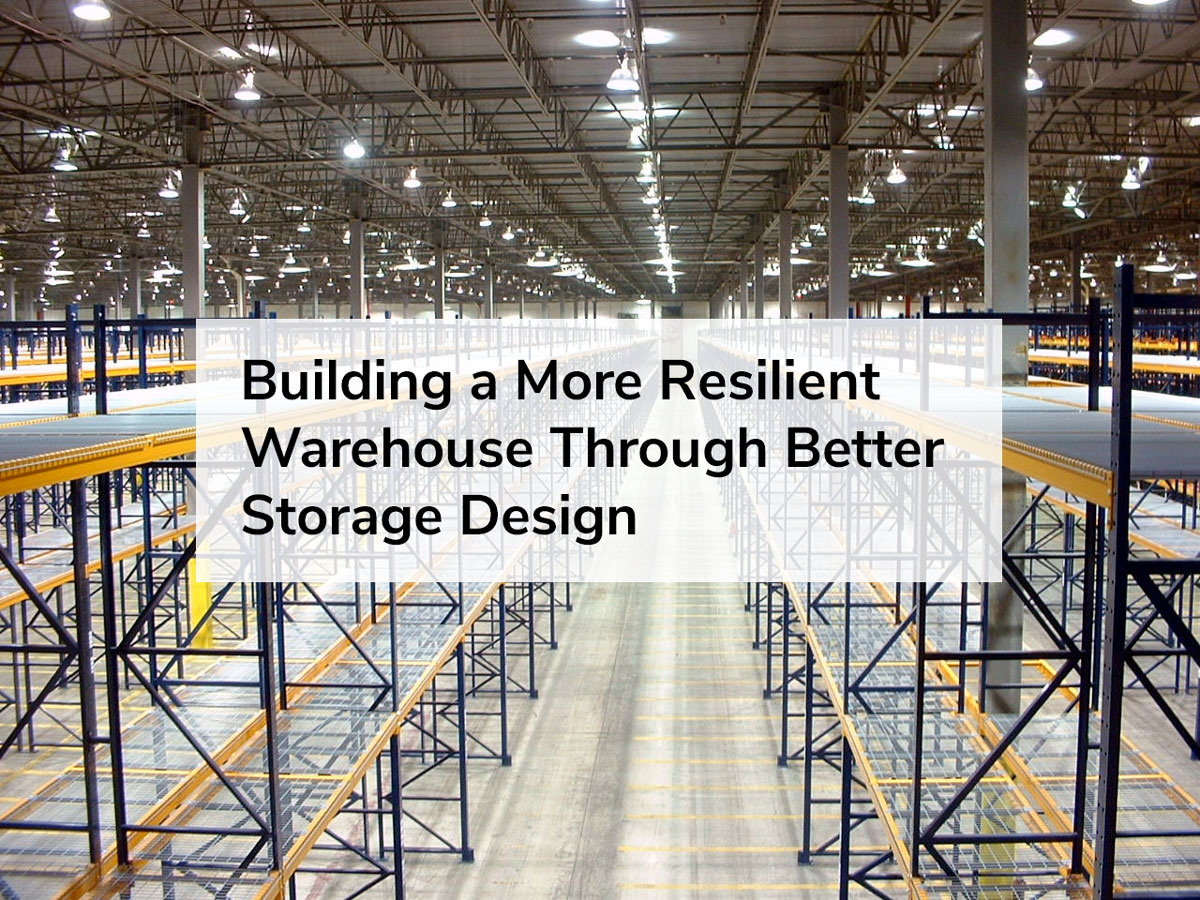
Warehouse storage design is no longer just about holding inventory. It is now a strategic tool for managing risk. A resilient warehouse absorbs unexpected volume spikes and pivots quickly when SKU profiles change.
Building resilience requires a storage design focused on modularity, density, and data. A strong framework helps maintain service levels, even during significant market stress.
Contact Us
High-Density Storage for Risk Mitigation
Storage density now acts as operational insurance. A facility running near capacity with selective racking has little room for safety stock or unexpected arrivals.
This lack of buffer makes the operation more vulnerable to disruptions. High-density solutions, such as pushback, Twinlode™, or double-deep racking, increase capacity without expanding the building.
Consolidating storage creates usable space for peak seasons. Extra capacity enables organizations to hold more inventory during volatile times, ensuring customer orders are filled even if shipments are delayed.
High-density systems also improve product consolidation. Inventory management becomes simpler, and shipping errors decrease. Modern warehouse resilience starts with enough stock to handle global uncertainty.
Designing for Modularity and Scalability
A main challenge in warehouse management is the fixed nature of storage infrastructure. Once racking is bolted to the floor, it becomes difficult and costly to change.
Resilience requires scaling up or down with demand. Today’s leading facilities use modular designs, allowing quick reconfiguration with minimal disruption.
Modular components offer flexibility. They can accommodate different pallet heights and can be rearranged to create more aisle space for automation. Flexibility ensures the storage system evolves with the business.
For example, a facility might shift from bulk goods to smaller e-commerce items. Modular systems adapt to new SKU mixes, helping avoid costly overhauls and supporting agility when markets change.
Integrating Storage with Predictive Technology
Warehouse resilience increases when storage is linked to digital systems. Many facilities use Warehouse Execution Systems (WES) to manage the flow of goods. Predictive analytics anticipate order surges and help move fast-moving items to more accessible locations before peaks.
This proactive approach to slotting ensures that the most active parts of the racking system are optimized for speed, while slower items are stored in high-density zones.
When the warehouse’s physical layout aligns with the management system’s digital intelligence, the facility can handle higher volumes with less stress on the labor force. A resilient design is one in which the racking and software work in tandem to eliminate bottlenecks and maintain a smooth flow of goods.
Diversifying Storage Zones for Operational Flexibility
Another key strategy for building resilience is creating diverse storage zones within a single facility. Rather than using a single type of racking throughout the entire building, a resilient design uses a mix of configurations.
For instance, a facility might use double deep racking for its core inventory, selective racking for its low-volume variety, and a dedicated zone for automated shuttle systems.
This diversification enables the warehouse to handle multiple product types and fulfillment requirements simultaneously. This approach also provides a backup plan if one area of the facility becomes congested.
If a specific product line experiences a sudden spike in demand, the facility can shift its labor and equipment to the high-density zone designed for that SKU profile.
By spreading its storage capabilities across multiple system types, a warehouse becomes better able to meet the diverse needs of its client base.
Maximizing Vertical Space as a Long-Term Strategy
With the cost of industrial land continuing to rise, the only direction left for many warehouses is up. Utilizing the full vertical height of a facility is a fundamental part of a resilient storage strategy.
Today’s racking systems are engineered to reach heights once inaccessible, allowing organizations to multiply their storage capacity within the same square footage. Utilizing space over dock doors is also gaining in popularity.
Vertical expansion increases total storage volume and defers costly relocations. This aspect is a crucial part of the financial strategy. Well-engineered tall-mast racking and suitable reach trucks boost density without new construction, leveraging vertical space as a critical asset.
Investing in a Resilient Future
Resilience is an ongoing distribution goal, reached by operational excellence and strategic design. By prioritizing density, modularity, and integrated technology, warehouses can transform storage systems into competitive advantages.
In today’s constantly evolving market, adaptability sets leading logistics operations apart. Building a resilient facility prepares organizations for future volatility.
Twinlode Automation, a KPI Solutions company, specializes in storage designs for modern complexities. Our team develops custom racking strategies that balance capacity, flexibility, and performance. We help you optimize space or design new facilities for resilience.
Contact us to see how our solutions support your long-term goals.