


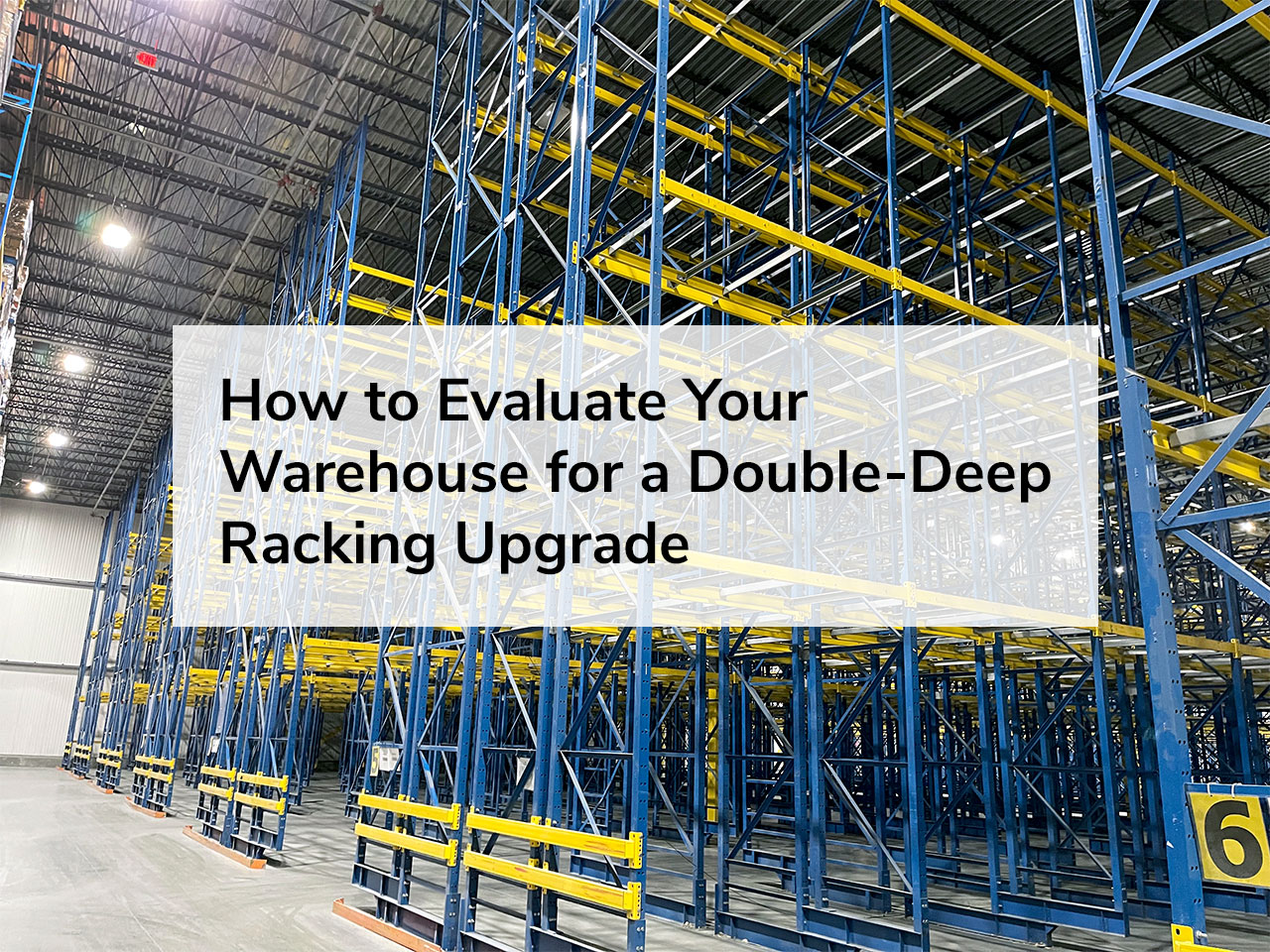
30 Mar How to Evaluate Your Warehouse for a Double-Deep Racking Upgrade
Warehouse managers operating in 2026 face an industrial landscape defined by high demand and the constant need for spatial efficiency. As facilities reach their physical limits, the decision to upgrade storage infrastructure becomes a central part of strategic planning.
Transitioning from a standard selective racking setup to a double deep racking system represents a significant shift in how inventory is handled and stored. This upgrade requires a comprehensive evaluation of current operations to ensure that the new configuration supports long-term goals.
Success in this transition depends on a detailed understanding of space utilization, aisle geometry, and equipment requirements. By conducting a thorough audit of these factors, an organization can determine whether a double-deep solution provides the necessary path to improved storage density and operational resilience.
Contact Us
Evaluating Space Utilization and Storage Density
The initial step in any racking evaluation involves a deep analysis of how the current floor area is allocated. Selective racking provides immediate access to every pallet, yet it requires a high number of aisles to maintain that accessibility.
When you examine your facility, you should focus on the ratio of storage space to travel paths. When a large portion of your square footage is occupied by aisles rather than inventory, you can reclaim that space for higher-density storage.
A double-deep racking system works by placing two rows of racking back-to-back. This layout allows the removal of every second aisle, significantly increasing the number of pallet positions available within the existing building walls. To evaluate the potential impact of this change, you should map your current capacity and compare it with a proposed double-deep layout.
This process is an exercise that helps identify how much additional inventory can be housed without the need for facility expansion or off-site storage. When the goal is to maximize the utility of every square foot, analyzing the storage-to-aisle ratio is the most effective starting point.
Analyzing SKU Velocity and Inventory Flow
A successful upgrade to double deep racking requires a close look at the specific characteristics of your inventory. Because this system stores pallets two rows deep, it naturally follows a Last-In, First-Out logic within each storage slot.
Analyzing SKU velocity delivers a system that is most effective when the facility manages high volumes of identical products. If your operations involve large batches of the same SKU, the reduced accessibility of the rear pallet position is generally manageable.
You should perform a detailed audit of your SKU movement patterns over a significant period. Focus on identifying products that consistently arrive and depart in multiple pallet quantities. When data indicates that a substantial portion of your inventory consists of high-volume items, a double-deep system can store them more efficiently.
Conversely, if your facility primarily handles a wide variety of unique items with low stock levels per product, the evaluation might reveal that a different high-density solution is required to avoid empty or inaccessible storage slots. Matching the racking depth to the volume of your SKUs is a critical component of the evaluation process.
Assessing Aisle Configuration and Building Geometry
The warehouse’s physical structure dictates the possibilities for a racking redesign. You must consider the placement of building columns, the ceiling height, and the location of essential safety systems, such as fire sprinklers. When you move to a double deep configuration, the orientation of your aisles may change. You need to ensure that the new rack uprights are positioned so as not to compromise the building’s structural integrity or obstruct clear emergency egress paths.
Aisle width is another vital consideration during the evaluation phase. While a double-deep system reduces the total number of aisles, the remaining aisles must provide sufficient clearance for the specialized equipment needed to reach the second pallet position. You should also take this opportunity to evaluate the warehouse’s lighting and ventilation systems.
Higher-density storage can sometimes impact light levels or airflow in the lower levels of the rack. Ensuring that the facility infrastructure supports a denser storage environment is essential to maintaining a safe and productive workspace.
Equipment Requirements and Mechanical Compatibility
A racking system cannot function in isolation from the machinery that services it. Standard counterbalanced forklifts are typically unable to reach the second pallet position in a double deep rack. Therefore, your evaluation must include an audit of your current material handling fleet.
To operate a double-deep system, you will need reach trucks equipped with telescopic forks or a pantograph mechanism. These features allow the operator to extend the forks into the structure to safely retrieve or place the rear pallet.
You should assess the age, condition, and lift capacity of your existing trucks.
- The current fleet is not compatible with a deep-lane system; the cost of acquiring new equipment must be included in the overall project budget. Furthermore, consider the lift heights required for your facility.
- The plan to utilize vertical space more effectively, you must ensure that your reach trucks have the stability and mast height necessary to work at the highest levels of the rack.
Evaluating the synergy between your racking and your equipment prevents operational bottlenecks after the installation is complete.
Structural Integrity and Flooring Standards
Increasing the density of your storage system inevitably leads to higher point loads on the warehouse floor. When you store twice as much inventory in the same footprint, the weight transferred through the rack uprights to the concrete slab increases.
It is important to consult with a structural engineer to verify that your flooring can support these increased loads without cracking or shifting.
This evaluation is particularly important in regions prone to seismic activity. High-density racking systems must be engineered to meet specific safety standards that ensure stability during a seismic event. You should review the original building specifications and compare them to the requirements of the new racking design.
If the floor requires reinforcement or if the rack bases need specialized anchoring, these factors should be identified early in the planning stages. Ensuring that the warehouse’s physical foundation is prepared for the upgrade is a fundamental safety requirement.
Planning for the Future and Determining ROI
The final component of your evaluation involves assessing the long-term return on investment. While the transition to a double deep system involves capital expenditure for both racking and equipment, the benefits are realized through improved operational efficiency. You should consider the savings from avoiding a move to a larger facility or from reducing utility costs per pallet stored.
In 2026, the ability to scale operations quickly is a major competitive advantage. A double deep system provides a level of density that allows for growth within the current footprint. By completing a comprehensive evaluation of your space, inventory, and equipment, you can ensure that your racking upgrade is a strategic success.
This preparation enables you to build a more resilient supply chain capable of meeting the evolving demands of the global market.